
05 May 2026 · 7 min read
What Are Mic Foam Covers Actually Made Of?
Microphone foam covers look identical to the untrained eye. They are not. The material composition affects sound, lifespan, print quality, and whether it survives a real podcast.
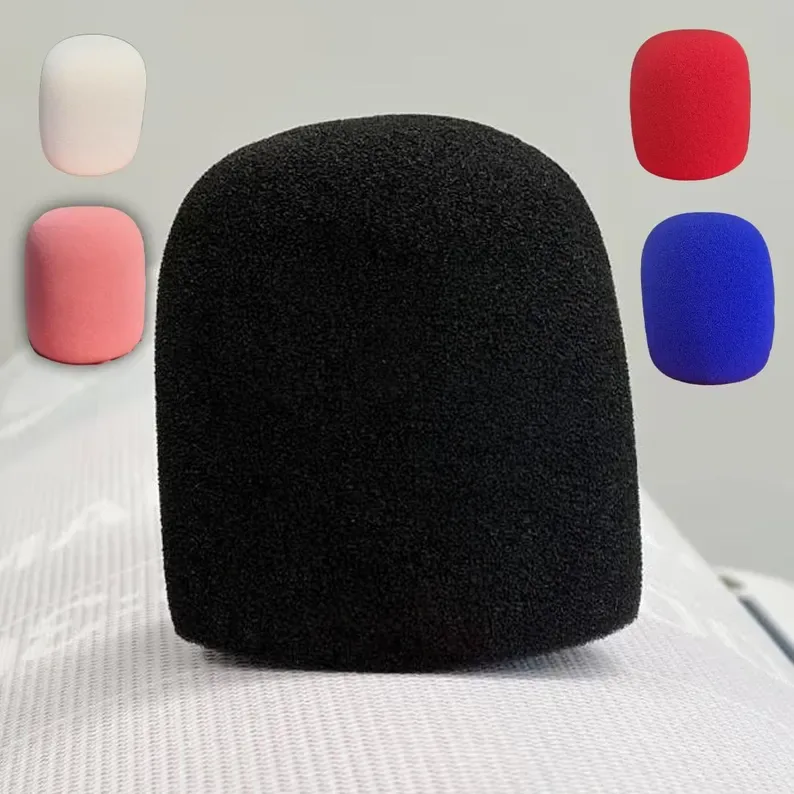
To the untrained eye, all foam mic covers look identical. They're not. Three materially different types of foam dominate the market, and the difference between them affects sound, lifespan, print quality, and whether your cover survives an actual year of use.
Here's what's actually in the foam.
The three foam types you'll encounter
1. PU foam (Polyurethane) — the good stuff
Most premium custom mic covers are PU foam. Open-cell structure, slightly bouncy to the touch, recovers shape after compression.
Pros:
- Acoustically transparent (doesn't muffle the mic)
- Dye-sublimation prints embed cleanly into the surface
- Lasts 2-4 years with regular use
- Stays flexible across temperature swings
- Survives sweat/breath moisture without immediate breakdown
Cons:
- More expensive raw material (~3× PE)
- Degrades faster in UV (yellowing in 12-18 months of direct sunlight exposure)
This is what we use for all our standard covers, and what every reputable UK mic-cover shop uses.
2. PE foam (Polyethylene) — the budget stuff
The cheap foam used in Amazon-listed "fits all mics" covers. Closed-cell structure, stiffer, no spring back after squeezing.
Pros:
- Very cheap
- Doesn't absorb water (waterproof)
Cons:
- Acoustically dead in the upper midrange (3-6 kHz)
- Tears at seams within 5-20 wear cycles
- Print quality is poor — colour sits on the surface, abrades fast
- Stiffens in cold weather
- Brittle, breaks rather than flexes
If you've bought a £6 mic cover from Amazon and it tore within 6 months: it was PE foam.
3. Reticulated foam — the broadcast specialist
Reticulated foam is PU foam that's been chemically processed to remove the cell walls, leaving only the skeleton (the open lattice between cells). Looks more like a sponge structure under magnification.
Pros:
- Extremely acoustically transparent (less wind/plosive than even regular PU, but more open)
- Doesn't trap moisture or odour
- Used in high-end broadcast windscreens and pop filters
Cons:
- More expensive than standard PU
- Slightly more fragile to handling
- Not as good for printing — the open structure makes high-detail prints harder
You'll see reticulated foam in Rode WS-series windshields, Rycote products, and high-end broadcast mics. We use it in some specialist orders but standard PU is what most podcast/event customers need.
Why the difference matters
For a podcast setup recording at 10-25cm from the mouth:
- PU foam is right. Doesn't muffle, lasts years, prints cleanly. £20-30 retail.
- Reticulated foam is overkill but works. £40-60 retail.
- PE foam is wrong. Cheap, but it'll cost you a replacement within 6 months. £6-10 retail.
For a live-vocal SM58:
- PU foam with slightly denser cell structure. Handles sweat and handling. Same £20-30.
- Reticulated foam doesn't suit — too open, transmits moisture too freely.
For an outdoor mic in wind:
- Furry (wool/synthetic) over a PU foam core is the right combination.
- Plain PU foam alone doesn't kill wind effectively.
How to tell what you have
Squeeze the cover gently:
- Springs back fast = PU foam
- Stays compressed = PE foam (bad)
- Almost no resistance, feels mesh-like = reticulated PU foam
Smell it:
- Mostly odourless = PU
- Slightly plastic smell = PE
- Almost nothing = reticulated PU
Look at the surface up close:
- Visible bubble-like cells = closed-cell PE
- Visible open cells in a roughly even pattern = open-cell PU
- Visible sponge-like lattice with no cell walls = reticulated PU
What this means for buying decisions
When you're shopping for a custom mic cover, the foam type is usually not on the product page — most sellers don't disclose it. You can usually tell from the price.
Under £10 retail: almost certainly PE foam. Avoid.
£15-30 retail: typically PU foam. Standard for the UK market. Reasonable quality.
£30-50 retail: PU foam with custom printing. What we and most reputable UK makers charge.
£50+ retail: reticulated foam, or PU with very high-end printing/material. Specialist use.
We use standard medium-cell PU foam for our podcast covers and slightly denser PU foam for our live-vocal SM58 covers. Both at £20-30 retail depending on the mic.
Why this matters for print quality
The foam type also affects how well the print holds up:
- PU foam + dye sublimation = print embeds into the foam surface. Lasts years, doesn't crack.
- PU foam + screen print = ink sits on the surface. Lasts ~2 years before cracking around bend points.
- PE foam + any print = poor adherence. Cracks and flakes within 6-12 months.
If you've ever owned a custom cover where the print started peeling after a year, the underlying foam was probably PE. The print method matters, but the substrate matters more.
Bottom line
You're not buying foam. You're buying a year of professional-looking audio kit. PU foam at £20-30 gets you that. PE foam at £6 gets you a replacement order in six months.
Browse foam covers by mic model — we're transparent about what's inside ours.
Types of microphone windscreens — and when foam is the wrong one
Foam is one of three families of windscreen. Knowing which you have tells you what the foam is doing and when to simply replace it.
1. Foam windscreens (indoor)
The open-cell PU covers this article is about. Their job is plosive control: the burst of air on P, B and T sounds that hits the microphone capsule. Foam breaks that burst up before it arrives, with minimal high frequency loss — a good PU cover shaves a fraction of a dB above 10 kHz, which is why it is the default on handheld vocal mics, podcast mics and lecterns. Indoors, with no moving air, this is all the noise reduction you need.
2. Furry windscreens (outdoor)
Outdoors the problem is not plosives but wind. Moving air across a bare capsule produces low-frequency rumble that no EQ removes cleanly. A furry windscreen — synthetic fur over a foam or mesh core, nicknamed a "dead cat" — adds an outer layer that slows the air down before it reaches the foam. The fur is what offers superior wind protection; the foam underneath still handles plosives. If you record outside, a furry layer over a PU foam core is the right pairing. Plain foam alone does not reduce wind noise enough to matter.
3. Blimps and shotgun windshields (location sound)
Shotgun microphones on film and broadcast sets use a basket "blimp" — a rigid mesh cage wrapped in fur — because the long interference tube is far more wind-sensitive than a vocal mic. The cage creates a pocket of still air around the mic, blocking the wind entirely. Rycote and Rode build these; they are not printable and not what a podcast or event mic needs.
Which one you need
- Podcast, streaming, speeches, singing indoors — foam. Branded foam if the mic is on camera.
- Vlogging, interviews outside, sports commentary — furry over foam. The amount of wind decides how thick the fur needs to be.
- Shotgun mic on a boom — blimp.
Whichever type you use, the foam core is the part that wears. Once it stops springing back when squeezed, sound quality and plosive rejection both drop — at that point simply replace it rather than cleaning it again.
Shop the gear in this guide
Ready to brand your microphone?
Custom microphone branding and same-day printing from London E1. Production 1–2 working days after artwork approval.
Browse the shop